
Lactose · Visual journey
Why can milk upset your gut?
Lactase is an enzyme that helps digest lactose, the sugar in milk. Let’s look at the surface where it works.
Scroll to look closer.
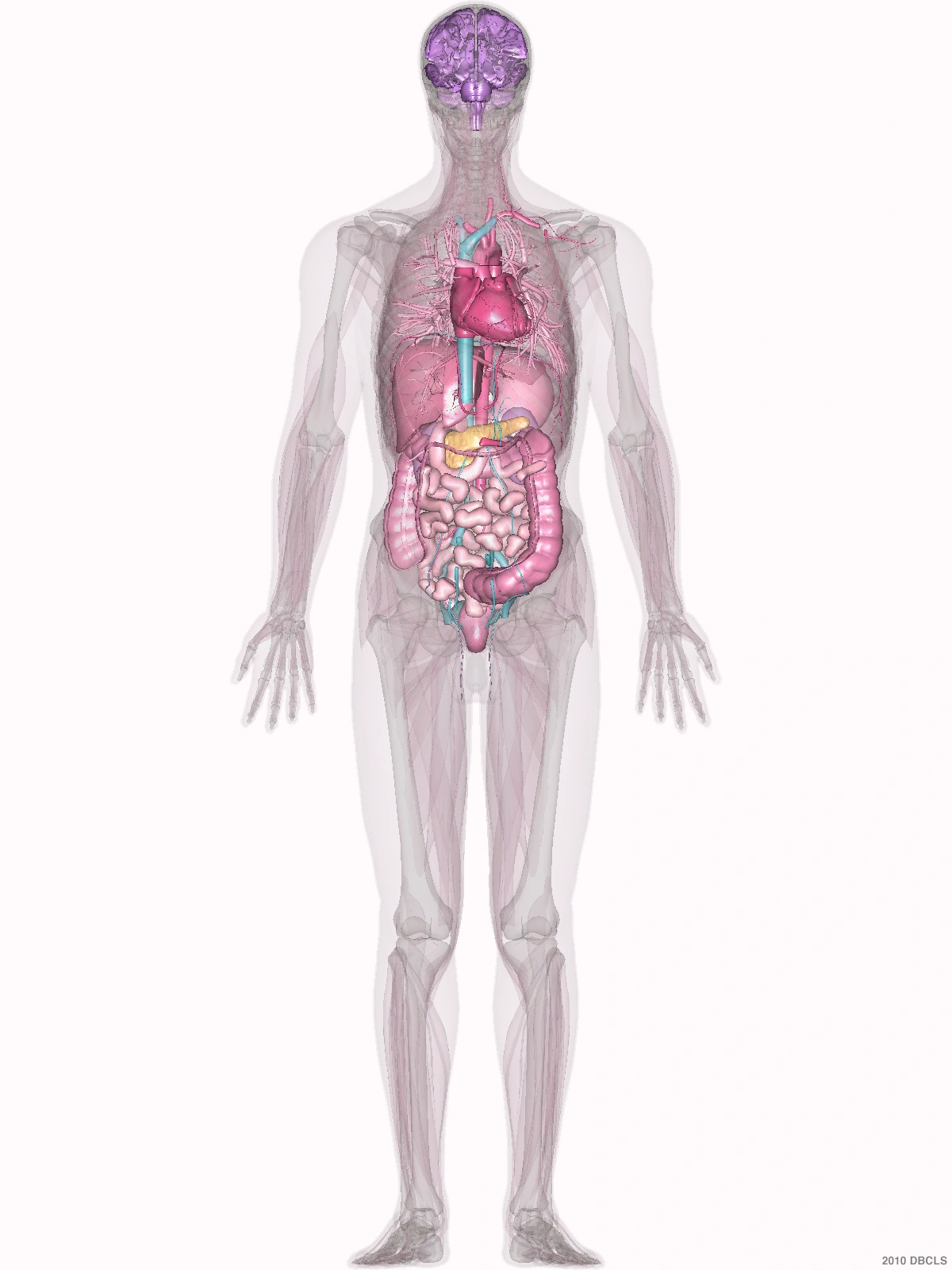
Small intestine
This is where lactose is digested.
In the small intestine, lactase breaks it into smaller sugars the body can absorb.
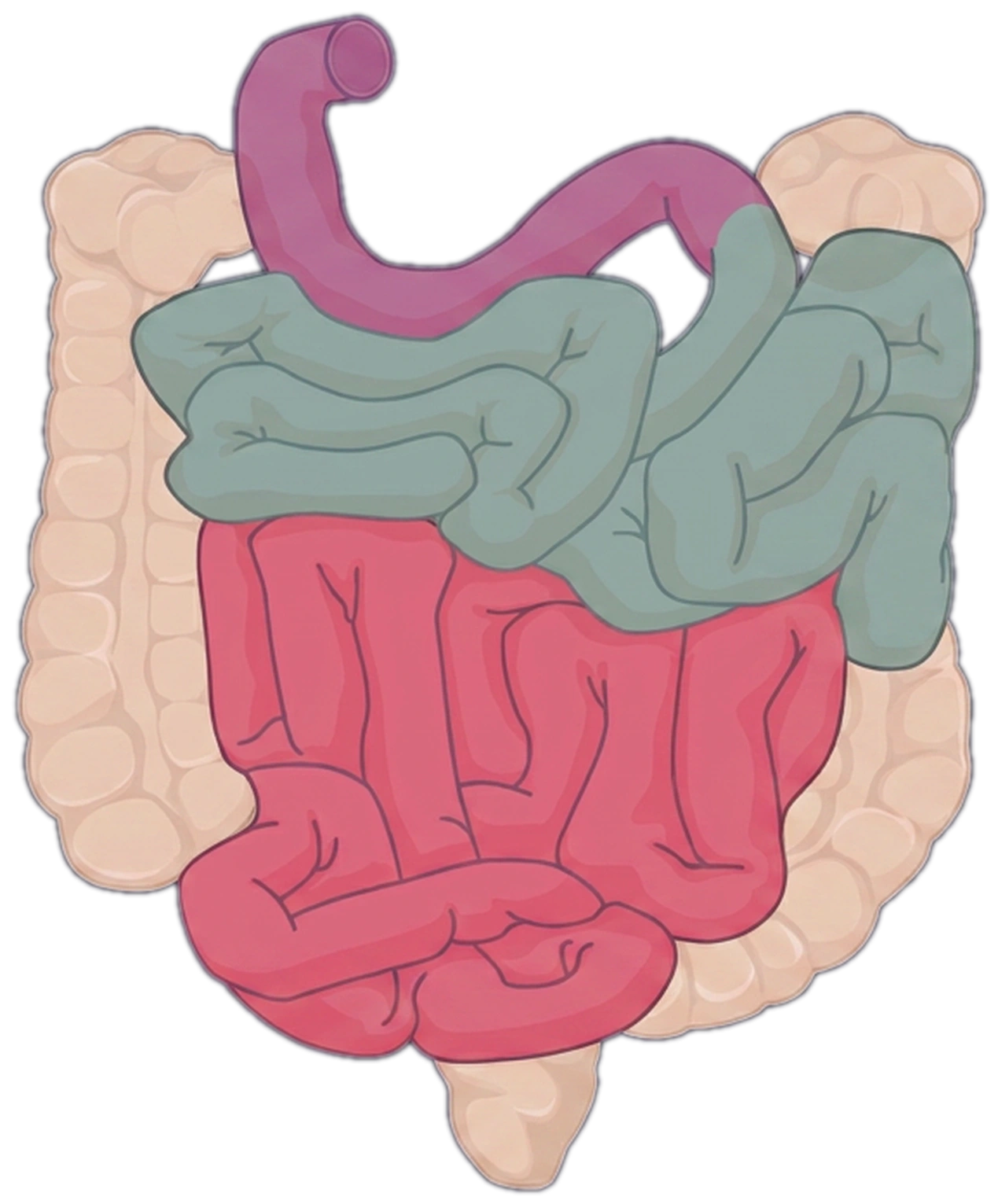 The entire small intestineThe differently colored loops form one organ, from the stomach to the colon
Intestinal surface
Lactase works at the surface.
Villi are projections of the intestinal lining. They are covered by cells that absorb nutrients. Lactase sits in their brush border, the fine fringe along the outer surface.
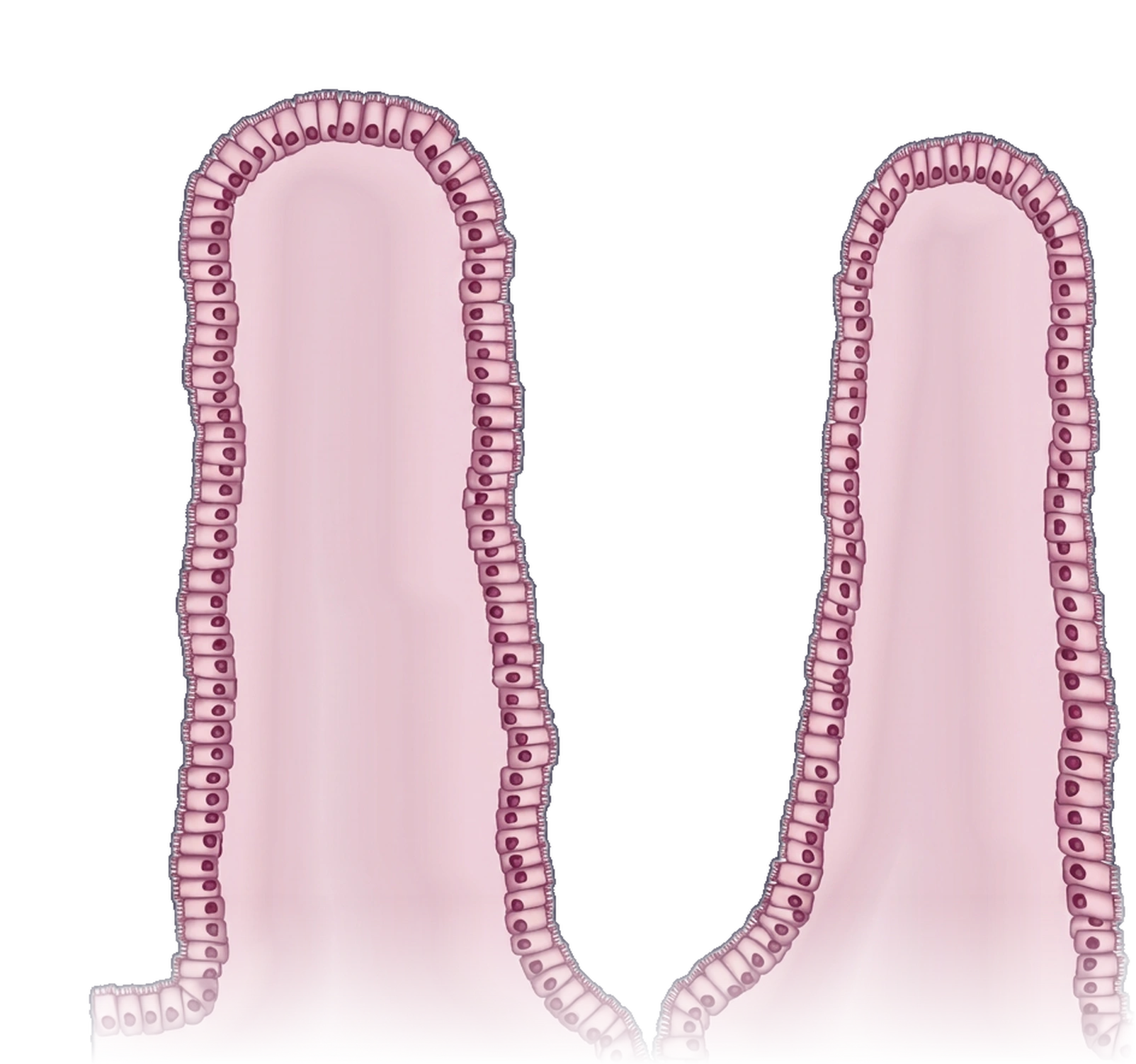 Brush borderThe enzyme that digests lactose sits here
The structure can stay intact.
Many people produce less lactase after childhood. Their villi can keep their shape: looking at them under a microscope does not measure how well the enzyme works.
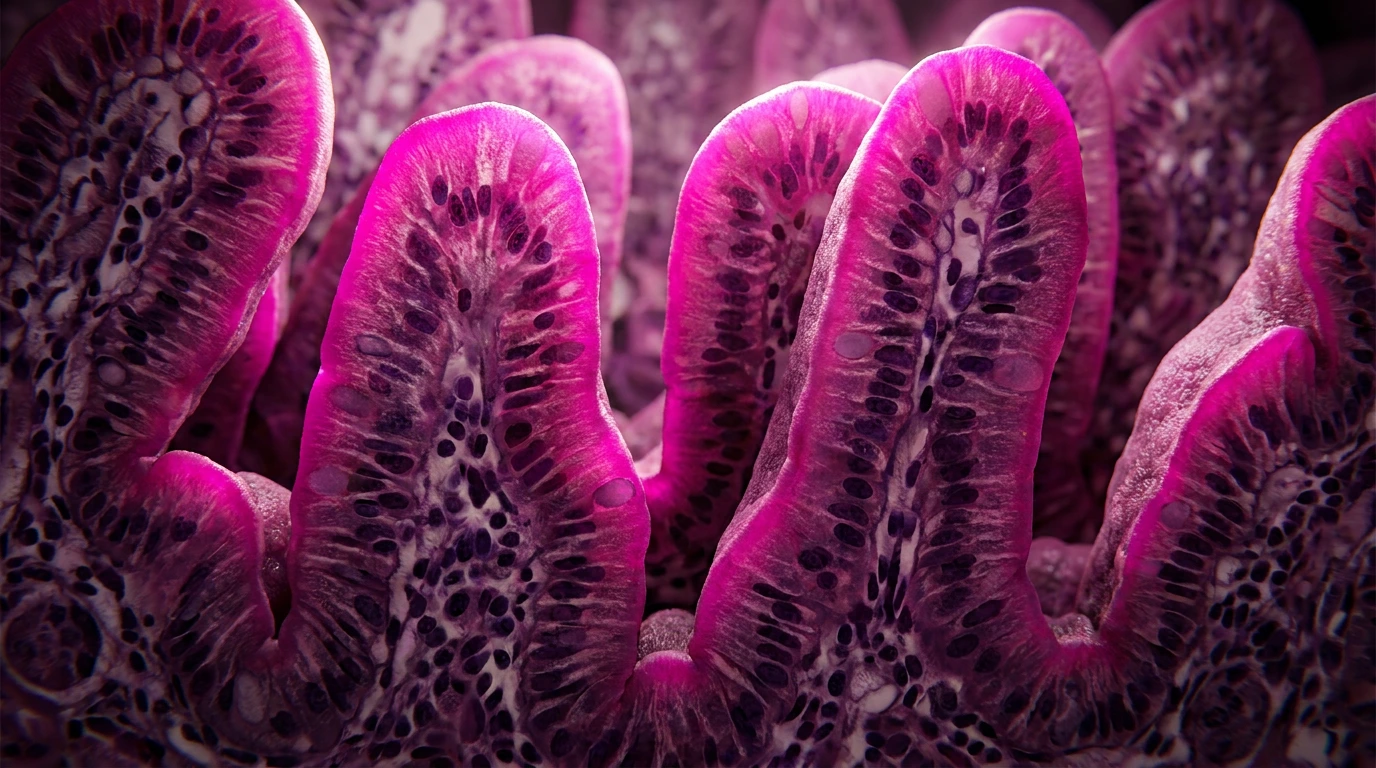
What happens inside
Symptoms begin when lactose reaches the colon.
When lactase is low, some lactose reaches the colon. Bacteria ferment it and produce gas; fluid also increases. This can cause bloating, cramps, and diarrhea.
This differs from milk allergy: allergy is an immune reaction to proteins; intolerance is difficulty digesting a sugar.
Under the microscope
Looking at villi does not provide a measurement of lactase.
These projections are villi, covered by a layer of cells. Assessing intolerance also requires a history of symptoms and, when needed, other tests.
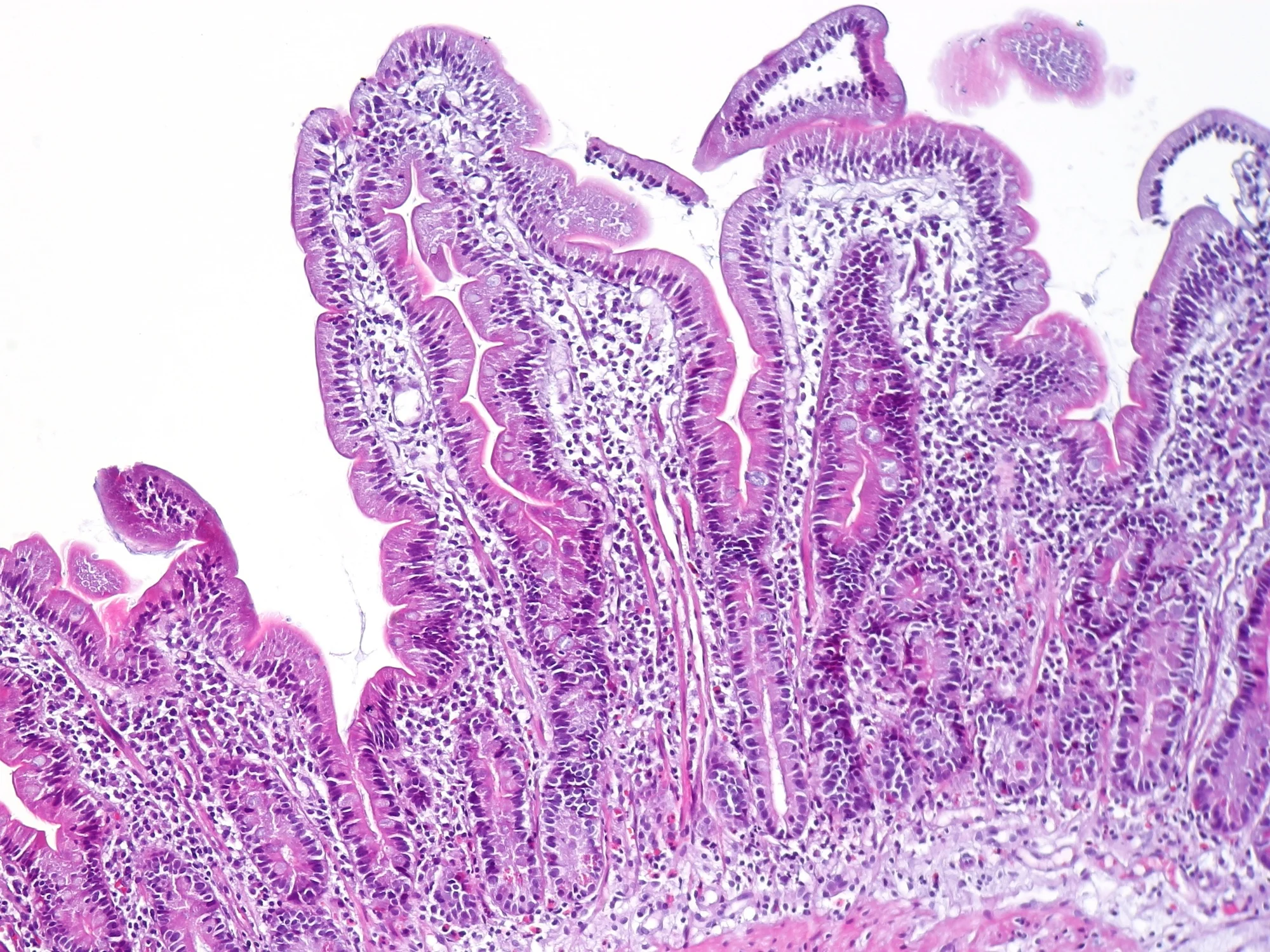 Tall villi
Duodenal biopsy · H&E. The source does not specify species. Used to identify villi, not to diagnose intolerance.
What you can do
Track when symptoms occur.
Note what you ate or drank, how much, and when symptoms started. Bring the notes to your visit: they help connect symptoms with food and assess whether another cause needs investigation.
I’m your friend, Dr. Carlo De la Sancha.
Medical transparencySources and scope
Medical evidence, image provenance, and the editorial transformations applied.
- Anatomical body model .. BodyParts3D / Anatomography · DBCLS, CC BY 4.0
- Anatomical illustration of the small intestine and colon .. OpenStax College, CC BY 3.0
- Illustration of intestinal villi and their brush border .. BallenaBlanca, CC BY-SA 4.0
- Duodenal biopsy with unremarkable mucosa, high magnification .. CoRus13, CC BY-SA 4.0
- Duodenal biopsy with unremarkable mucosa, intermediate magnification .. CoRus13, CC BY-SA 4.0
- Where lactase is expressed and why its amount varies between people .. Harvey et al., Gut, 1995
- Hypolactasia, lactose malabsorption, and intolerance are not synonyms .. Misselwitz et al., Gut, 2019
- Adult hypolactasia can coexist with normal villi .. Harvey et al., Gut, 1995
- What unabsorbed lactose does in the colon .. National Institute of Diabetes and Digestive and Kidney Diseases (NIDDK)
- Primary and secondary lactase deficiency .. National Institute of Diabetes and Digestive and Kidney Diseases (NIDDK)
- How many people worldwide have lactose malabsorption .. National Institute of Diabetes and Digestive and Kidney Diseases (NIDDK)
- Food allergy is an immune response, not an intolerance .. National Institute of Allergy and Infectious Diseases (NIAID)
- What hematoxylin and eosin staining shows .. National Cancer Institute (NCI)
- Preparing for a medical visit .. NHS · Food intolerance
The anatomical illustrations were cleaned to show one idea per frame: labels and guide lines were removed, the background was replaced with the journey canvas, and the anatomy was not redrawn. Where the original asset fell short of the final display size, resolution was increased from the same source without inventing or moving structures. The dramatic reveal is a generated reinterpretation of the cited biopsy, not a diagnostic reproduction. The structural reference is a crop of the original micrograph. The source does not document species; these images are not linked to a lactase measurement.
This journey explains a mechanism; it does not diagnose, prescribe, or recommend products, supplements, or medications. A biopsy is not the usual test for lactose intolerance: it appears here to identify villi, not to demonstrate their function.
Sources verified through September 1, 2026.