
Understand Your Body
Sent on
Why this boy kept bleeding without a single bump
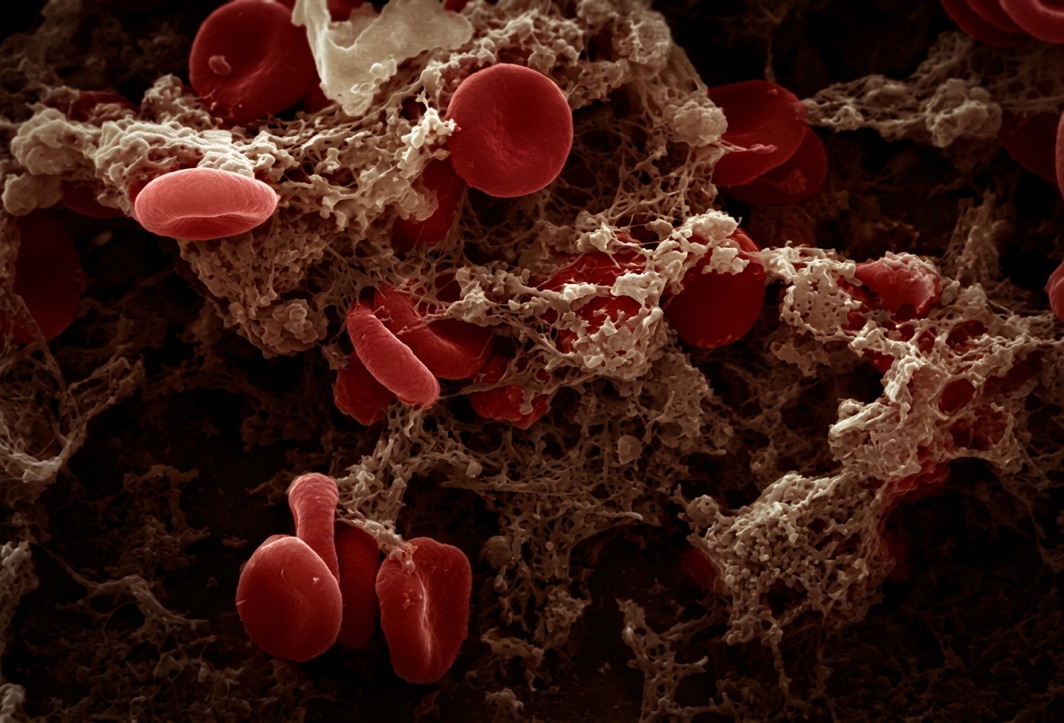
This is what the net that seals a wound looks like under the microscope: strands of fibrin trapping red blood cells. When this mesh doesn't form, there is nothing to stop the blood.
THE CASE
A boy came into the emergency room covered in bruises. On his back, on his buttocks... places you don't bump by accident. No one could remember a fall that would explain them, and the team's first suspicion was one of the hardest to say out loud: abuse. It's the right suspicion to raise, and it's never dismissed lightly. But a good clinician doesn't stop at the first hypothesis, and this boy's blood was about to tell a very different story.
THE INVESTIGATION
Before we get to why this boy is bleeding, let's look at how blood clots in anyone. When you cut yourself, your body builds a plug in two stages. First, platelets stick to the wound and form a quick but fragile patch. Then the real construction work begins: the clotting cascade, a line of proteins called clotting factors that switch each other on like falling dominoes until they weave a fibrin mesh that seals the cut.
Four of those factors share a secret. We call them II, VII, IX, and X, and none of them works without a finishing touch that only vitamin K can provide. And vitamin K gets used up as it works. That's why the liver has an enzyme, VKORC1, that gets it ready to be used again. Pure recycling. As long as that recycler keeps working, the factory never stops and the blood clots right on schedule.
The team draws the boy's blood, and his clotting times are through the roof (the PT and INR, which measure how fast the blood weaves that fibrin mesh). That no longer points to an injury. It fits blood that has stopped clotting properly. Then someone checks the house and the clue turns up: a blue powder under the kitchen sink. Rat poison.
Sometimes blood that won't clot isn't telling a story of violence. It's telling a story of chemistry.
The poison in that rat bait, brodifacoum, does just one thing: it blocks VKORC1. It shuts down the recycler. With no recycling, vitamin K runs out and nothing is left to replace it; those four clotting factors come out half-finished and useless. The fibrin mesh no longer forms, and wounds stop sealing.
Here's the detail that gives away the timing of the bruises. Of those four factors, VII has the shortest lifespan: it lasts only a few hours in circulation. It's the first to run out when the factory shuts down. That's why clotting fails not right away but one to three days after exposure, and that's why the bruises show up days later, with no injury to explain them. The poison doesn't strike all at once... it waits for the warehouses to empty.
WHAT YOU CAN DO
What is in your hands
- Keep rat poison, other poisons, and chemicals locked up, out of reach of children and pets. This is the kind of accident you can prevent in a minute, and colorful powder attracts exactly the ones who shouldn't touch it.
- If you suspect a child has gotten into poison, don't wait for it to "pass": go to the emergency room. The antidote is simple, and it has a name: vitamin K, which replaces the very thing the poison was keeping the body from recycling.
- But it has to be medical-grade vitamin K (high doses, sometimes for weeks or months, adjusted by the doctor), not the kind in a supplement or in food. And because it takes hours to work, if the child is already bleeding, the hospital also gives ready-made clotting factors to stop the bleeding right away.
- Red flags: bruises that appear without a bump, gums or nose that bleed easily, or blood in the urine or stool. That's not something to take lightly. See a doctor now.
IN SHORT
- Your blood seals a wound in two stages: a quick platelet patch, then a fibrin mesh that makes it firm.
- Four pieces of that mesh (factors II, VII, IX, and X) only work with a finishing touch of vitamin K.
- Vitamin K gets used up as it works; a liver enzyme, VKORC1, recycles it so it can be used again.
- Rat poison (brodifacoum) blocks that recycler: without recycled vitamin K, the mesh doesn't form and the bleeding doesn't stop.
This boy was given vitamin K, and not just once. Brodifacoum is a superwarfarin, a much more potent and more persistent relative of common blood thinners; it stays lodged in the liver for weeks, sometimes months. That's why his treatment was long, lasting until the poison finally let go. His blood began clotting again. What first raised the hardest suspicion of all turned out to be a container under the sink... with a name, and with an antidote.
Dr. Carlo De la Sancha
Pathologist, professor, and researcher.
This is educational content, meant to help you understand your body. It is not a medical consultation or a diagnosis. If something worries you, talk to a doctor you trust.
Images are digitally enhanced from real tissue for illustrative purposes. Base image: electron micrograph by Janice Carr / CDC (public domain).