
You asked
Will putting my baby in the sun clear up the yellowing?
This question came from the comments on this video:
 Why babies turn yellow .. and why blue light treats it
Hearing Spanish on YouTube? Tap ⚙ › Audio track › English
No. Sunlight is not a safe way to treat jaundice. The yellow color comes from bilirubin, and a newborn's liver needs a few days to clear it out. With sunlight, there is no way to measure the dose or keep the baby's skin safe during exposure. Phototherapy is what brings bilirubin down.
Why does the hospital's blue light bring bilirubin down while sunlight does not?
Hospital lamps concentrate light in a narrow band of 460 to 490 nanometers, which changes bilirubin in the skin. Sunlight contains that band too, but there is no way to measure how much of it reaches the baby. That is why the American Academy of Pediatrics does not consider sunlight a safe treatment. Phototherapy is the treatment: the baby is undressed and placed under the lamp.
What if your baby is born in winter and there is no sun?
Winter changes nothing. Phototherapy uses a lamp, so it works the same in January as in July, whether in the hospital or, sometimes, at home. There are also fiber optic blankets that deliver blue light directly to the baby's skin. The bilirubin level determines the treatment.
How do you know if your baby needs a bilirubin test rather than time in the sun?
You cannot tell from color alone, and yellowing is harder to see on darker skin. That is why bilirubin gets measured before discharge. If your baby went home before 48 hours of age, a follow-up check takes place within two days. If the yellowing reaches the arms and legs, or your baby is hard to wake or not feeding well, your baby needs to be checked that same day.
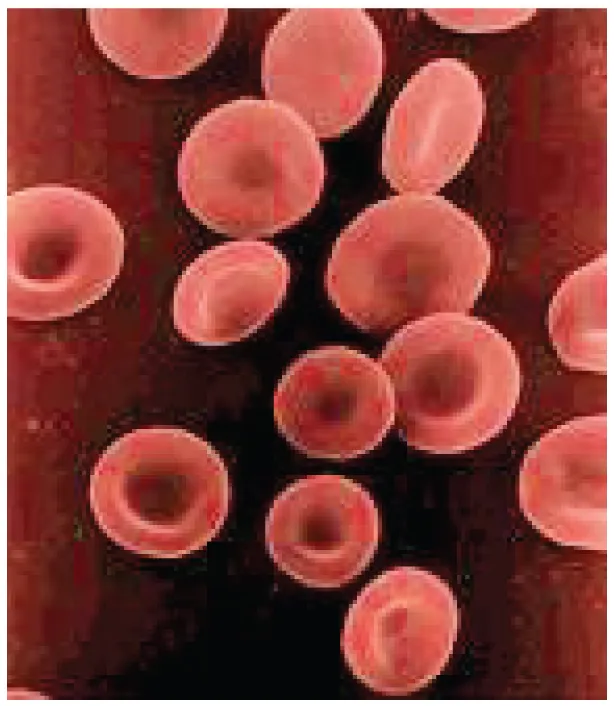
Illustration: OpenStax College, Shape of Red Blood Cells (Anatomy & Physiology), CC BY 3.0. Unmodified.

Where this comes from
- AAP (HealthyChildren.org): putting a baby in sunlight is not a safe way to treat jaundice, and any baby with jaundice in the first 24 hours needs an immediate bilirubin measurement.
- NICE CG98: section 1.4.7 advises against sunlight as treatment for hyperbilirubinemia; sections 1.2.10 and 1.2.12 call for serum bilirubin measurement within 2 hours and medical assessment within 6 hours for jaundice in the first 24 hours, to rule out pathological causes; section 1.2.6 advises against estimating the level by visual inspection.
- Bilirubin photoisomerization review (PMC, 2025): blue light (approximately 460–490 nm) converts bilirubin into water-soluble isomers that are eliminated without further hepatic conjugation.
- Centers for Disease Control and Prevention (CDC): accessed 2026-09-20
- CDC .. Jaundice and Kernicterus: Information for Families: accessed 2026-09-20
This is educational content, meant to help you understand your body. It is not a medical consultation or a diagnosis, and it does not tell any particular person what to do. If something worries you, see a doctor you trust.