
Understand Your Body
Sent on
The Exhaustion That Wasn't From Her Period
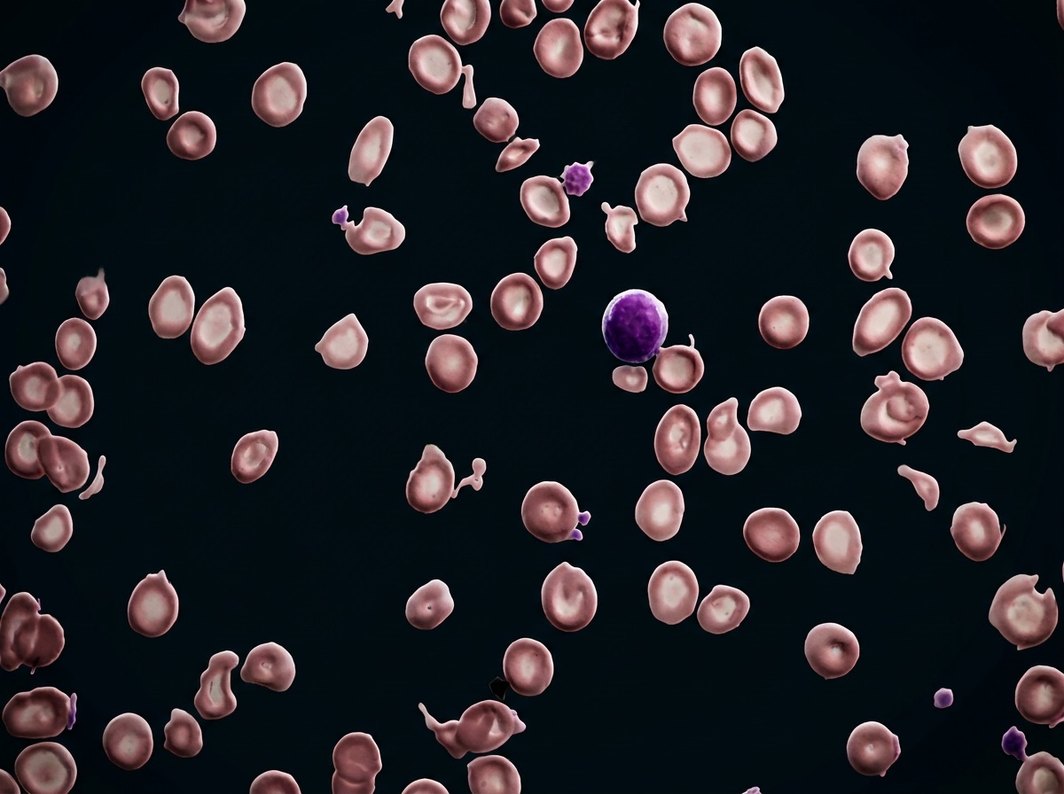
Iron-deficient blood under the microscope. The red blood cells look smaller and paler.
THE CASE
A 38-year-old woman came in exhausted. She had been that way for more than a year, getting winded on stairs she used to climb without a second thought. Her tests showed iron-deficiency anemia, and the explanation seemed obvious: her period. She was given iron, she got better, she stopped taking it, and within a few months the anemia was back. Twice. That was what didn't add up: her periods had never been heavy, and the iron was going in but not staying. One question had never been asked: where is it leaking out? The answer was in an organ you have too, one that works silently and almost never gives a warning when trouble starts.
THE INVESTIGATION
Start with a healthy colon. Its lining is made of glands that look like test tubes, side by side, all alike: they make mucus and absorb water and salts. Their nuclei are small and round, and they stay tucked at the bottom of the tube.
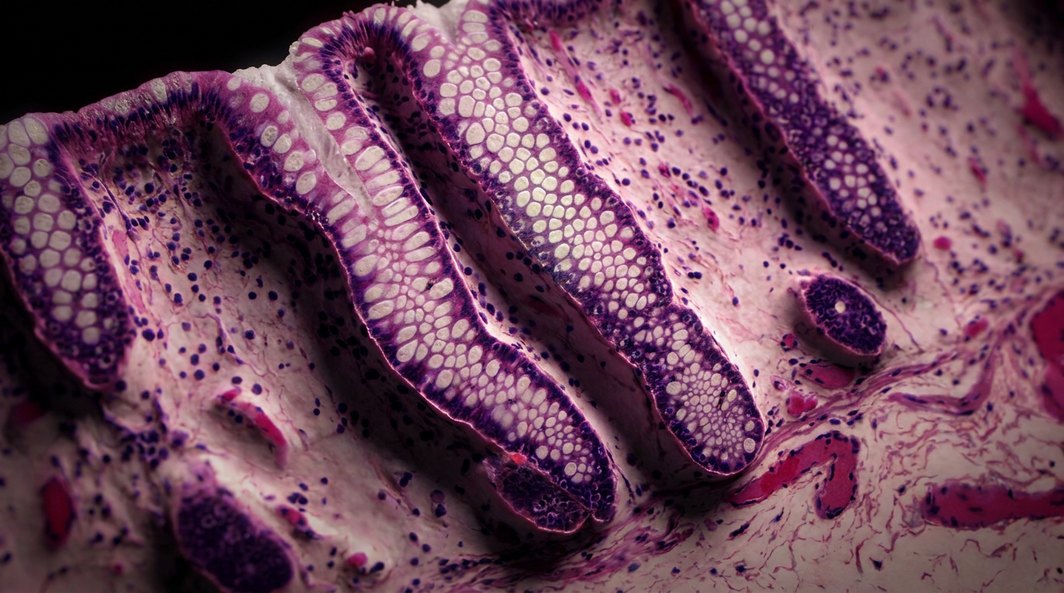
Healthy colon under the microscope. The glands are orderly tubes, side by side.
In a polyp, those same cells change their behavior: they look bigger, darker and crowded together, and they no longer stay at the bottom. They climb toward the surface. That has a name, adenoma: it is not cancer yet, but it can head in that direction.
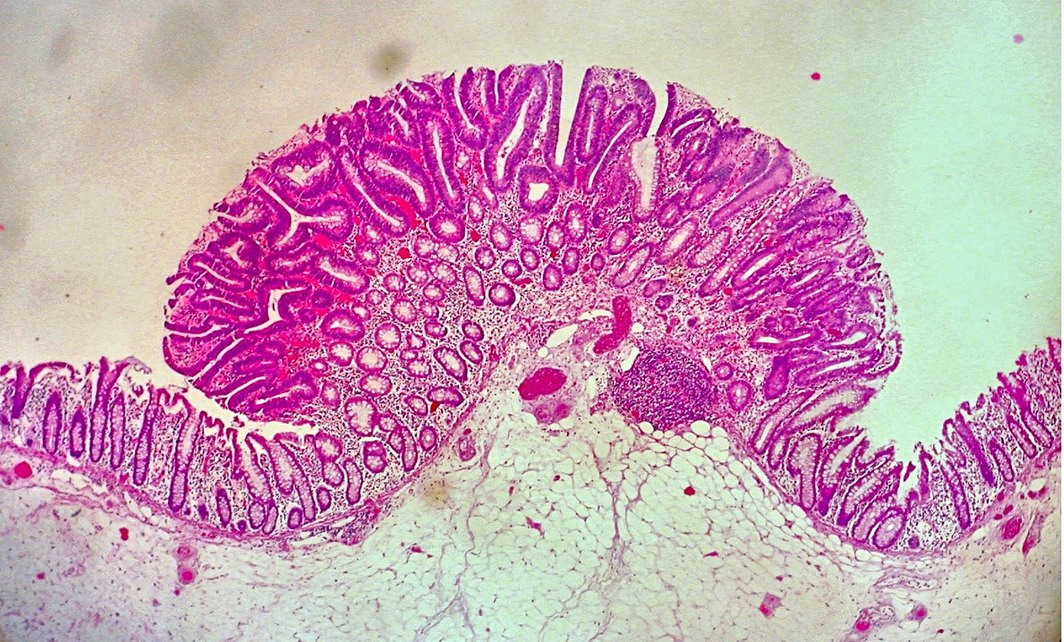
A polyp under the microscope (tubular adenoma). In the center, the polyp: long, crowded glands that form a bump. On either side, healthy lining: short, even glands lined up in a row.
Why do they go off track? Because of mutations that pile up. The first one usually hits a gene called APC, whose job is to keep the "grow and divide" signal switched off. When APC breaks, that signal stays on and the cell keeps multiplying on its own. If nobody removes that little bump, other mutations can add up, and that is when cancer appears.
And here is the important part: that road is slow. Getting from a polyp to a cancer usually takes years, often more than ten.
Now, the detail almost nobody knows: a polyp doesn't hurt. And when it bleeds, it bleeds so little that you can't see it. That is why the test is called a fecal occult blood test, occult meaning hidden: it looks for what your eye can't catch. Drop by drop, that invisible loss drains away your iron. Unexplained anemia can be the first sign of something in the colon.
So why is colon cancer hitting younger and younger people? In Mexico, deaths from colorectal cancer before age 50 are rising about 2.5% a year in men. The cause is still being studied, but there is a clue: colibactin, a toxin that damages DNA. Here's the catch: not just any Escherichia coli makes it. This bacterium lives in the gut of almost all of us, but only some strains carry the machinery to produce the toxin, and not everyone has those strains. The toxin's fingerprint shows up much more often in tumors from young people, and one of its targets is APC itself.
So what does that mean for you? There is no routine test to look for this bacterium and no treatment to get rid of it, and you don't need either. What you can change is what you eat: in two studies that followed more than 130,000 people for years, a Western-style diet, heavy in red and processed meat, sugar and refined flour, was linked mainly to tumors that carried a lot of this bacterium. It seems the diet doesn't bring the bacterium in; it gives it an edge. Meanwhile, the age at which this cancer strikes is shifting: colon cancer is no longer just a disease of older people. If you are 30 or 40 and notice blood in your stool, a change in your bowel habits or anemia nobody can explain, don't brush it off because of your age: tell your doctor.
Unexplained anemia can be the first sign of something in the colon.
And the woman from the beginning? Her colonoscopy found a large polyp in the right colon, exactly where the hidden bleeding that causes this kind of anemia comes from. It was removed completely, right then and there. Under the microscope: adenoma, not cancer.
WHAT YOU CAN DO
What is in your hands
- If you are at average risk, screening starts at age 45 (it used to be 50). There are two good options: a colonoscopy every ten years, or a stool test for hidden blood (FIT) every year. Both work: what matters is that you get one. If the stool test comes back positive, the next step is a colonoscopy.
- Before 45, what counts is your family history. If anyone in your family had colon cancer, especially before 50, tell your doctor: you may need to start earlier.
- As in her case, iron-deficiency anemia that keeps coming back, or that doesn't fit with your periods, deserves a search for the cause, not just another prescription for iron.
- More fiber, more physical activity, and less processed meat (ham, hot dogs, bacon), which is classified as a carcinogen for the colon, and less red meat (beef, pork, lamb), which is classified as probably carcinogenic.
- And these can't wait, even though they may not be cancer: blood in the toilet at any age, a change in your bowel habits that has lasted for weeks, pain that won't go away, or losing weight without trying. If you have any of these, see your doctor.
IN SUMMARY
- When colon cells crowd together and climb upward, that is an adenoma: the step before cancer.
- The first mutation usually breaks the APC gene, and getting to cancer takes years, often more than ten. That slowness is our advantage.
- A polyp doesn't hurt, and its bleeding is almost never visible. That is why anemia can be the first warning.
That woman no longer runs out of breath on the stairs. She will need regular surveillance, but the polyp that was stealing her iron is gone. Her body had been warning her for a year in the only way it could: with iron that wouldn't stay.
Dr. Carlo De la Sancha
Pathologist, professor and researcher.
This is educational content, meant to help you understand your body. It is not a medical consultation or a diagnosis. If something worries you, talk to a doctor you trust.
Blood and polyp images: Ed Uthman, CC BY 2.0, via Wikimedia Commons.
The images are digitally enhanced photos of real tissue, for illustrative purposes.